
You missed a day. Here's what actually happens.
You missed a day. In Winny, the counter goes back to zero and every win you have ever logged is still there: nothing deleted, nothing locked. The research on daily habits agrees that one missed day doesn't undo what you built.
What happens in Winny when you miss a day
The counter resets to zero. Every logged win stays.
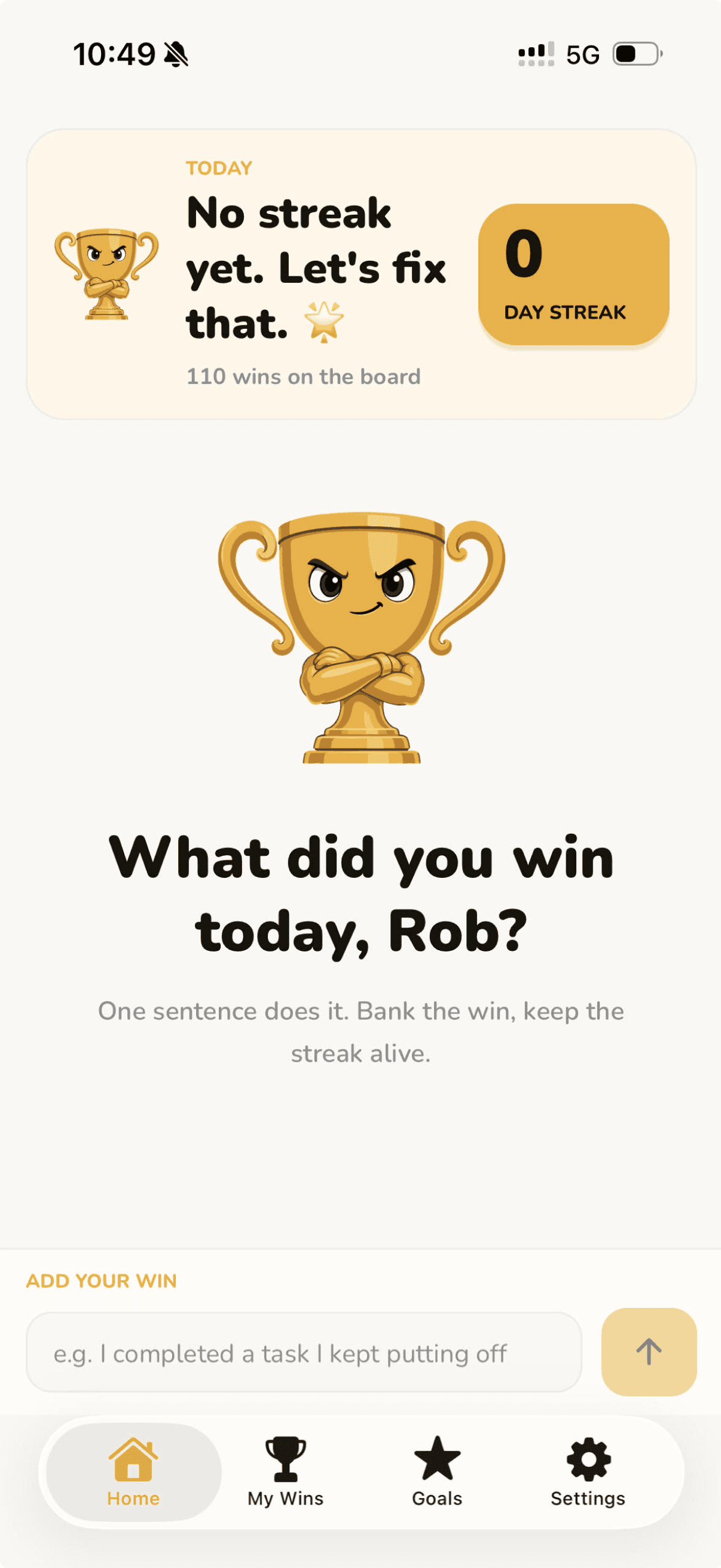
There is no grace period and no token to buy the number back, because the number counts days in a row and that is the one thing it would be lying about. The history does not move: the wins stay dated, listed and scrollable, exactly as they were the evening before.
A missed day is a calendar day with no win logged, and that is the whole definition. Not a day that went badly, not a day you were too tired to think of anything good, just a day with nothing written down. The count notices it. Nothing else does.
Does missing a day undo your progress?
No.
The same University College London researchers looked at 140 occasions when someone missed a single day, and found the dip in automaticity the next day was too small to matter and left no lasting cost to the habit.
In their words, missing one opportunity to perform the behaviour did not materially affect the habit formation process.
That is a narrower finding than it is usually quoted as, and the narrowness is the useful part. The same research is less relaxed about missing a week, which is exactly why the next day matters more than the one you missed.
It is worth knowing the size of the thing before leaning on it. The study followed 96 volunteers, most of them postgraduate students, taking up eating, drinking and exercise behaviours; none of them was keeping a journal. The test behind the missed-day result was non-significant, which means no cost was detected rather than that none exists. It is the best evidence anyone has on the question, and it is still one study of one kind of habit.
Why Winny keeps a counter at all
Because a number you can see is a reason to come back, and removing it would remove the nudge along with the pressure.
A counter can be two different objects depending on what the app around it does. It can be a debt: something you own, can lose, and get reminded about in those words. Or it can be a receipt for having shown up, where the number is a by-product and the practice is the thing.
Winny takes the second reading. Nothing in the app dramatises a reset: no mark against the day you missed, no notification about a run being in danger, no offer to repair it for a fee. The counter goes to one the moment you name a win, and the wins themselves never had a number attached to them in the first place. The longer version of what the counter is counting is on how to start a winning streak.
That is also why the number is kept small and plain. It sits on the home card and goes up by one when you write something. It is not the first thing the app says to you, it is not what the app is for, and on the evening it goes back to zero the fastest way past it is to write the next line.
What to do tomorrow
Name a win: tonight if there is still an evening left, otherwise tomorrow. One is enough to restart the count, and if more than one turns up, log them all. The rest of the app carries on as though nothing happened, because nothing did.
If the gap was longer than a day, none of that advice changes; it just matters more. Pick the smallest true thing about today and write that one down. Got out of bed on a week you did not want to. Answered the message you had been avoiding. An entry you would be faintly embarrassed to read back is still an entry, and it is worth more tonight than a good one would have been last week.
The only version of this practice that fails is the one you stop doing. A day you missed is not that.

The count starts again tomorrow. Everything you logged is still yours.
Sources
- Lally, P., van Jaarsveld, C. H. M., Potts, H. W. W., & Wardle, J. (2010). How are habits formed: Modelling habit formation in the real world. European Journal of Social Psychology, 40(6), 998-1009. doi.org/10.1002/ejsp.674
Last updated: 22 September 2026