
How to start a winning streak.
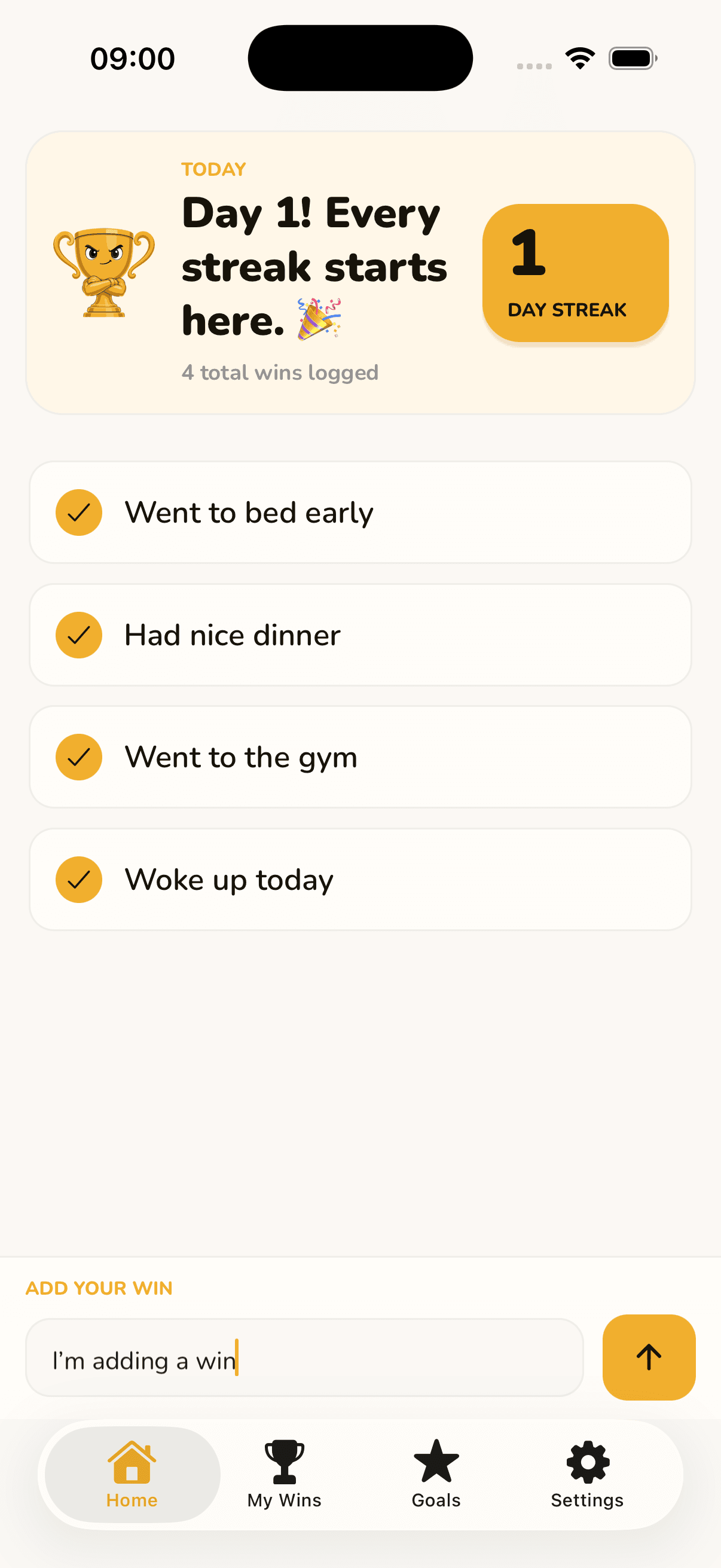
A winning streak is a run of days where you noticed something went right. Not a run of perfect days, but a run of days you paid attention. You start one by naming one win tonight, and you keep it by doing the same tomorrow. Winny is a thirty-second app for the naming part, but the practice works just as well in a notebook.
What a winning streak actually means
It is not a run of victories, and it is not a run of luck. It is a run of days you noticed one thing that went right.
The distinction matters because almost nobody controls whether a day goes well. Plenty of them will not. What you can control is whether you stop at the end of one and look for the part that did, which is a far smaller ask than making tomorrow better than today.
That is why the count is days rather than achievements. An evening whose only good thing was a decent cup of coffee counts the same as the evening a deal closed, because the thing being practised is the looking. Once the looking is a habit, most of the wins turn out to have been there already; you were walking past them.
It also explains why the phrase survives contact with a bad month. A run of victories would end the first time something went wrong, which is soon, and then there would be nothing to keep. A run of days you paid attention can survive almost anything, because there is no day so poor that nothing in it went right, only days you did not stop to check.
How to start one tonight
Name at least one win at the end of today. Write it down. Do the same tomorrow. There is no step four.
Notice.
The end of the day is the only moment you can see the whole of it, which is why the practice sits there rather than in the morning. Ask it as a question instead of a demand: what went right today? Something did. It rarely looks impressive from the outside, and that is fine, because the ordinary ones are the ones a difficult week still hands you.
Stack.
Writing it down is the step people skip and the step that does the work. A win you merely thought about is gone by morning. A win you wrote down is still there next week, in your own words, which is much harder to argue with than a memory. Writing is also what turns separate days into a run: one line is a note, sixty lines are evidence. Log them one at a time as they occur to you, or all at once at the end; the app does not mind which.
Repeat.
Tomorrow is the only commitment you make. Not thirty days, not a year, not a resolution that will feel like a debt by February. If you can name one win tomorrow evening, the run is intact, and that is a promise small enough to keep on the days a larger one would break.
How many wins should you log a day?
As many as you notice. One is the floor, not the target, and on most evenings you will find more than one once you have started looking.
The reason the floor is one rather than three is what happens on a bad day. Ask for three good things and the evening you can only find one becomes a failure at the exercise, which is exactly backwards: that evening is the one where noticing anything at all is worth the most. Ask for one and the same evening clears the bar by definition.
Above the floor there is no ceiling. Log the deal and the coffee and the thing you finally said out loud, in three separate lines if that is how they arrived. Nothing counts them against you, and a day with six on it is not worth more than a day with one; it just left you more to read back.
What happens when the streak breaks
The counter goes back to zero. Nothing else moves: every win you have logged is still in the app, still dated, still readable. You begin a new run by naming a win today.
The longer answer, including what the research actually says about a single missed day, is on what happens when you miss a day.
Is this a gratitude journal?
It is like a gratitude journal, but for wins. Gratitude asks what you are thankful for; this asks what you pulled off.
The two are close cousins and they rhyme in practice, but the question points in a different direction. Thankfulness looks outward, at what came to you. A win looks at what you did with the day, or decided, or simply got through, including the unglamorous ones: the email finally sent, the argument not started.
If keeping a gratitude journal has never stuck for you, that difference is worth a week of trying. The same evening produces two very different lists depending on which of the two questions you ask it.
Win streak or winning streak?
People type both, and they mean the same thing. This site says winning streak throughout, because that is the phrasing the idea arrived with; the number itself is just the streak counter inside the app.
Worth saying because the search results for the two phrases drift apart. Type the shorter one and a lot of what comes back is sport: a team that has won five in a row. Type the longer one and more of it is about the practice described here. Neither is wrong, and nothing on this page depends on which one brought you.
Where the winning streak idea comes from
Charlie "Rocket" Jabaley started saying "I'm on a winning streak" around 2019, and it spread: a TEDx talk, podcast after podcast, a lot of people repeating it. His own way of putting it: see possibility, take the next win, stack momentum. He's never published a step-by-step method, and he doesn't make an app.
Winny is one reading of that idea, cut down to thirty seconds a day. Notice, Stack and Repeat are Winny's words, not his. Winny is an independent app, not affiliated with Charlie Rocket and not endorsed by him; he has never reviewed it. If you want the idea from the source, his TEDx talk is Delusional Optimist (How To Start A Winning Streak).

I'm one person, and Winny is the app I wanted for myself.
Last updated: 22 September 2026