
A positive mindset is one habit, repeated.
A positive mindset isn't a mood you talk yourself into. It's what's left over from one small habit, done most days: at the end of the day, name one thing that went well. That's the whole practice. It takes about thirty seconds, and you can start tonight without an app.
The habit, named
At the end of the day, write down what went well, a line for each. That is all of it: no format, no prompts to work through, nothing to score, and one is enough on the evening that is all you have.
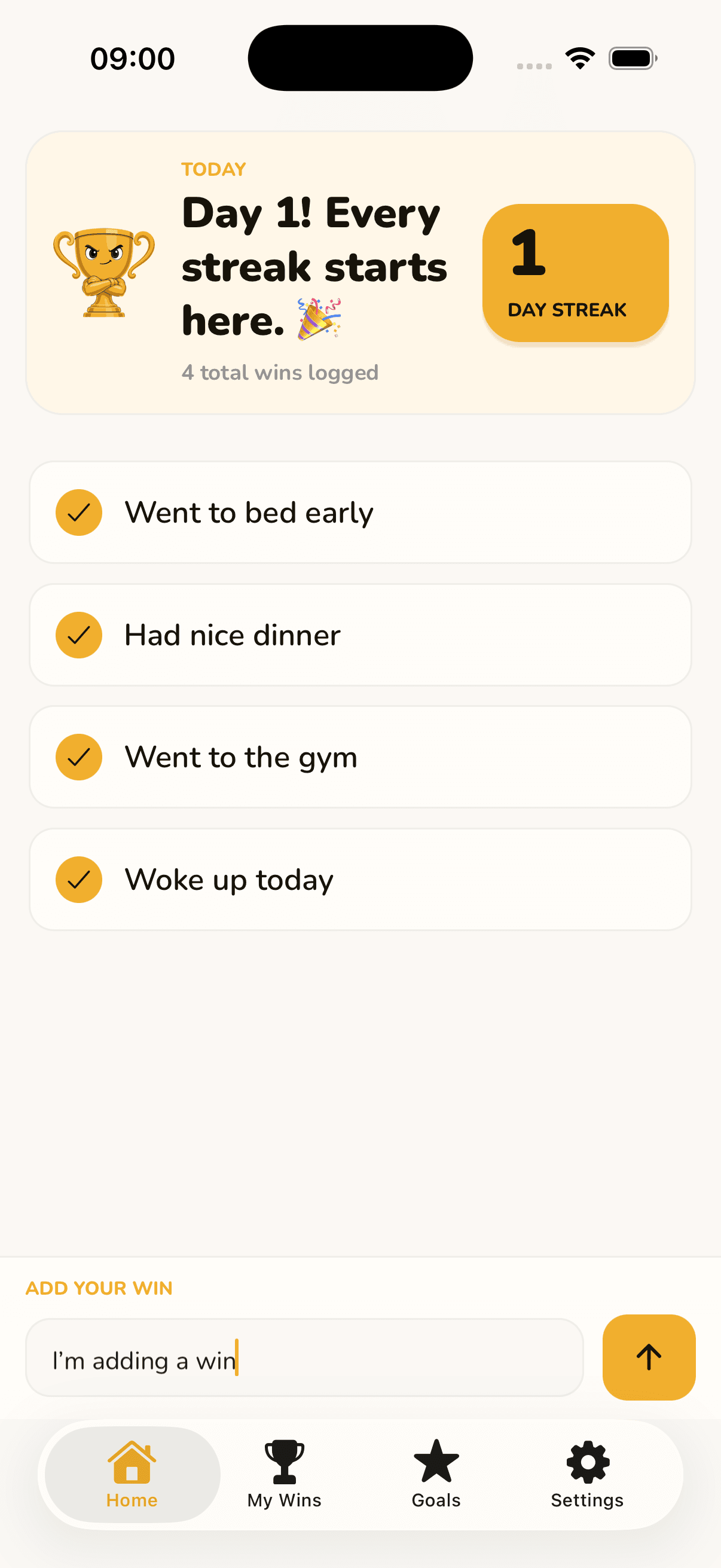
What turns it from an exercise into a habit is the time of day. Attach it to something already fixed in your evening, like putting the phone on to charge, and it stops needing a decision. Winny is a thirty-second version of this, though the habit is older than any app and has never needed one.
The one-line limit is doing more work than it looks like. A blank page invites an essay, and an essay is something you can be too tired to write; a single line is something you can do badly and still have done. Some evenings it will be a sentence you are proud of. Most evenings it will be five words about a phone call, and those count the same.
Why small wins do anything at all
Because small ones are what most days are actually made of, and which ones you notice changes the day you remember having.
Teresa Amabile and Steven Kramer spent four months reading the daily diaries of 238 people at work and found that the most common thing to happen on someone's best day was a small step forward, and that even minor progress lifted mood and motivation more than its size suggested.
That research is about work rather than life, and it measured making progress rather than writing it down, so treat it as a good reason to look for the small ones rather than as proof that an app will change your week.
The closest thing to a test of the practice itself asked for three lines, not one. A randomised trial by Martin Seligman and colleagues asked 577 people to write down three things that went well each day for one week, and the people who did it were measurably happier and less depressed six months later, though many of them had kept the habit up on their own.
So the honest reading is that the trial supports the shape of the habit rather than a particular count. Setting one as a floor rather than three as a target is the same practice on a good evening and a kinder one on a bad night, when the alternative is skipping the evening entirely and that is worth nothing at all.
What this is not
It is not an affirmation and it is not a quote deck, though a gratitude list is a close cousin.
Affirmations ask you to believe something that is not true yet. Quote decks ask you to be moved by someone else's sentence. Both work on the inside of your head, and both want belief before evidence. Naming a win asks for neither, because the thing already happened and your only job is to write it down.
Gratitude lists are the near relation, and if one is already working for you there is no reason to swap. The difference is which way the question points. Gratitude looks at what came to you; a win looks at what you did with the day, including the parts that were only just got through.
It is also not journalling in the long-form sense. Nothing here asks you to process the day, explain how you felt about it, or arrive anywhere by the end of the entry. One line, one thing that went well, and the evening is yours again.
How to start tonight, without an app
Open whatever is nearest and write one line about today. Paper, the notes app that came with your phone, the back of an envelope.
Only two things are worth being strict about: the time and the length. Do it at the end of the day, when there is a day to look at, and keep it to one line so tomorrow's version is never something you postpone. A week of one-line entries is enough to tell you whether the practice does anything for you, which is a cheaper test than any app purchase.
What an app adds is not the habit, it is the friction it removes: somewhere that is always the same place, a count you did not have to keep yourself, and no blank page to face. If paper already gives you that, paper is the better tool, and this page is happy to lose you to it.
How long before it sticks
Longer than a month, and the honest answer is that it varies enormously from person to person.
In the best-known study of the question, researchers at University College London tracked people taking up a new daily behaviour and found it took a median of 66 days for it to feel automatic, with individuals ranging from 18 days to 254.
So 66 days is a middle, not a deadline, and if yours takes longer than that you are still well inside what the research found.
Which makes the evening after a skipped one the part worth thinking about, and that has an answer of its own.

You can do this in a notebook. Winny makes it take thirty seconds.
Sources
- Amabile, T. M., & Kramer, S. J. (2011). The power of small wins. Harvard Business Review, 89(5), 70-80. hbr.org/2011/05/the-power-of-small-wins
- Seligman, M. E. P., Steen, T. A., Park, N., & Peterson, C. (2005). Positive psychology progress: Empirical validation of interventions. American Psychologist, 60(5), 410-421. doi.org/10.1037/0003-066X.60.5.410
- Lally, P., van Jaarsveld, C. H. M., Potts, H. W. W., & Wardle, J. (2010). How are habits formed: Modelling habit formation in the real world. European Journal of Social Psychology, 40(6), 998-1009. doi.org/10.1002/ejsp.674
Last updated: 22 September 2026